
Customers rarely interact with a brand through a single channel. They might discover you through a Google search, see your ad on Instagram, read reviews, and then visit your store or website before making a decision. This multi-touch journey is why businesses often confuse integrated marketing and digital marketing.
Both play important roles, but they serve different purposes. Digital marketing focuses on online visibility, traffic, and conversions. Integrated marketing focuses on aligning every channel, online and offline, into one consistent brand experience.
If you are trying to scale your business, generate leads, or build a strong brand, understanding how these two approaches differ will help you allocate budget, choose channels, and execute more effectively.
What Is Integrated Marketing?
Definition of Integrated Marketing
Integrated marketing is a strategic approach that unifies all marketing channels to deliver a consistent message and experience across the customer journey.
Instead of running disconnected campaigns, integrated marketing ensures that every touchpoint reinforces the same brand positioning, tone, and value proposition.
Core Components of Integrated Marketing
An integrated strategy connects multiple functions and channels:
- Traditional media such as TV, print, and radio
- Digital channels such as SEO, PPC, social media, and email marketing
- Public relations and brand storytelling
- Offline experiences such as retail, events, and activations
- CRM systems and sales alignment
- Customer support and post-purchase communication
The focus is not just on using multiple channels, but making them work together.
Key Characteristics
- Omnichannel execution with consistent messaging
- Customer journey mapping across touchpoints
- Alignment between marketing, sales, and brand teams
- Long-term focus on brand equity and trust
Example
A real estate developer launching a new project:
- Billboard ads generate awareness
- Social media showcases property visuals
- YouTube videos explain features
- Email campaigns nurture leads
- Site visits convert prospects
All communication uses the same messaging and visuals.
What Is Digital Marketing?
Definition of Digital Marketing
Digital marketing includes all online marketing activities used to attract, engage, and convert users through internet-based platforms.
Key Channels in Digital Marketing
- SEO for organic search visibility
- PPC advertising, such as Google Ads
- Social media marketing on platforms like Instagram and LinkedIn
- Content marketing, including blogs and videos
- Email marketing and automation
- Affiliate and influencer marketing
- Conversion Rate Optimization (CRO)
Key Characteristics
- Strong reliance on data and analytics
- Real-time tracking of performance metrics
- Targeting based on user intent, demographics, and behavior
- Funnel-based approach from awareness to conversion
Example
An e-commerce brand:
- Uses SEO to rank for product keywords
- Runs Google Ads for high-intent searches
- Retargets visitors through Meta Ads
- Sends email reminders for abandoned carts
Integrated Marketing vs Digital Marketing: Key Differences
Comparison Table
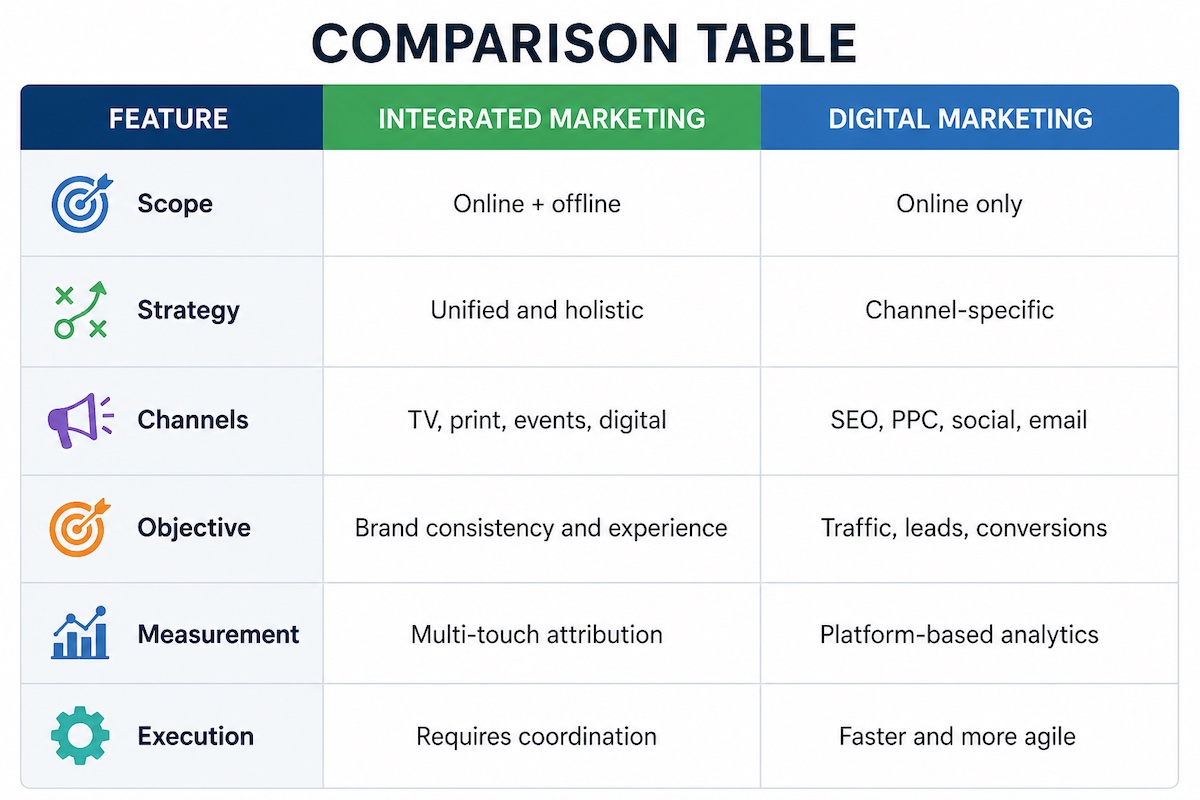
The main difference is scope. Integrated marketing connects everything, while digital marketing focuses only on online growth.
How Integrated Marketing and Digital Marketing Work Together
Digital marketing is a core component of integrated marketing.
Integrated marketing uses digital channels to track behavior, retarget audiences, and measure campaign effectiveness. This allows businesses to connect offline efforts with measurable outcomes.
For example:
- A billboard drives users to a website
- A QR code connects offline to digital
- Retargeting ads bring users back to convert
Benefits of Integrated Marketing
Brand Consistency
Consistent messaging across platforms builds trust and recognition.
Customer Journey Alignment
Users experience a seamless transition between channels, reducing friction.
Stronger Brand Recall
Repeated exposure across different formats improves memory retention.
Long-Term ROI
Integrated campaigns build brand equity and reduce dependency on paid channels.
Benefits of Digital Marketing
Cost Efficiency
Digital campaigns require a lower initial investment than traditional media.
Measurable Results
You can track key metrics such as clicks, conversions, and ROI in real time.
Targeting Precision
Campaigns can target users based on intent, behavior, and demographics.
Speed and Optimization
Campaigns can be adjusted instantly based on performance data.
Challenges of Integrated Marketing
- Requires coordination across teams and channels
- Higher upfront investment
- Complex attribution models
- Risk of inconsistent messaging if not managed properly
Challenges of Digital Marketing
- High competition in search and paid ads
- Dependence on platforms like Google and Meta
- Continuous optimization required
- Limited offline visibility
When Should You Use Integrated Marketing?
Ideal Use Cases
- Brand-building campaigns
- Product launches
- Expansion into new markets
- Businesses with multiple customer touchpoints
Relevant Industries
- Retail and consumer brands
- Real estate and infrastructure
- Healthcare systems
- Automotive
When Should You Use Digital Marketing?
Ideal Use Cases
- Lead generation and sales campaigns
- Startups with limited budgets
- Performance-focused strategies
- E-commerce growth
Relevant Industries
- E-commerce
- SaaS
- Local service businesses
- Online education
Integrated Marketing vs Digital Marketing: Which Is Better?
The better approach depends on your goals.
If your focus is brand positioning and long-term growth, integrated marketing is more effective. If your focus is leads, traffic, and conversions, digital marketing delivers faster results.
Most businesses benefit from a hybrid approach that combines both.
Real-World Examples
Integrated Marketing
A large retail brand runs:
- TV ads for awareness
- Outdoor advertising for visibility
- Influencer campaigns for reach
- Social media for engagement
All channels share the same messaging.
Digital Marketing
A direct-to-consumer brand:
- Uses Google Ads for intent-based traffic
- Builds organic reach through SEO
- Runs social media ads
- Uses email marketing for retention
How to Build an Effective Marketing Strategy
Define Objectives
Identify whether your goal is awareness, traffic, or conversions.
Map Customer Journey
Understand how users move from discovery to purchase.
Select Channels
Choose channels based on your goals and budget.
Align Messaging
Ensure consistency in tone, visuals, and value proposition.
Track KPIs
Monitor metrics such as traffic, conversion rate, CAC, and ROAS.
Future Trends in Marketing
- Omnichannel strategies are becoming standard
- AI-driven personalization
- Increased use of first-party data
- Integration of offline and digital analytics
- Greater focus on customer experience
Key Takeaways
- Integrated marketing connects all channels into one strategy
- Digital marketing focuses on online performance
- Digital marketing supports integrated campaigns
- Hybrid strategies deliver stronger results
- Channel selection should align with business goals
FAQs
What is the main difference between integrated marketing and digital marketing?
Integrated marketing includes both offline and online channels, while digital marketing focuses only on online platforms.
Is digital marketing part of integrated marketing?
Yes, digital marketing is a key component of integrated marketing.
Which is better for small businesses?
Digital marketing is more practical due to lower cost and faster results.
Can digital marketing work alone?
Yes, especially for online-first businesses.
What is an example of integrated marketing?
A campaign combining TV ads, social media, email marketing, and offline promotions.
Conclusion
At Impakt Digital, we see businesses struggle not because they lack channels, but because their channels are not connected.
Integrated marketing ensures your messaging stays consistent across every touchpoint. Digital marketing ensures your campaigns are measurable, optimized, and scalable.
At Impakt Digital, we build strategies where SEO, paid media, content, and conversion optimization work together as a system. This approach improves both performance and brand strength.
If you want predictable growth, focus on alignment, not just activity.